Skip to content
‹ All work

Race Dash Studio

Design the dash. Ship a manifest, not code.

A desktop designer that exports every dashboard as a compact binary manifest, and Zephyr/LVGL firmware that reads it at boot and builds the dash live from the car's CAN bus. Changing a layout never means generating or compiling code.

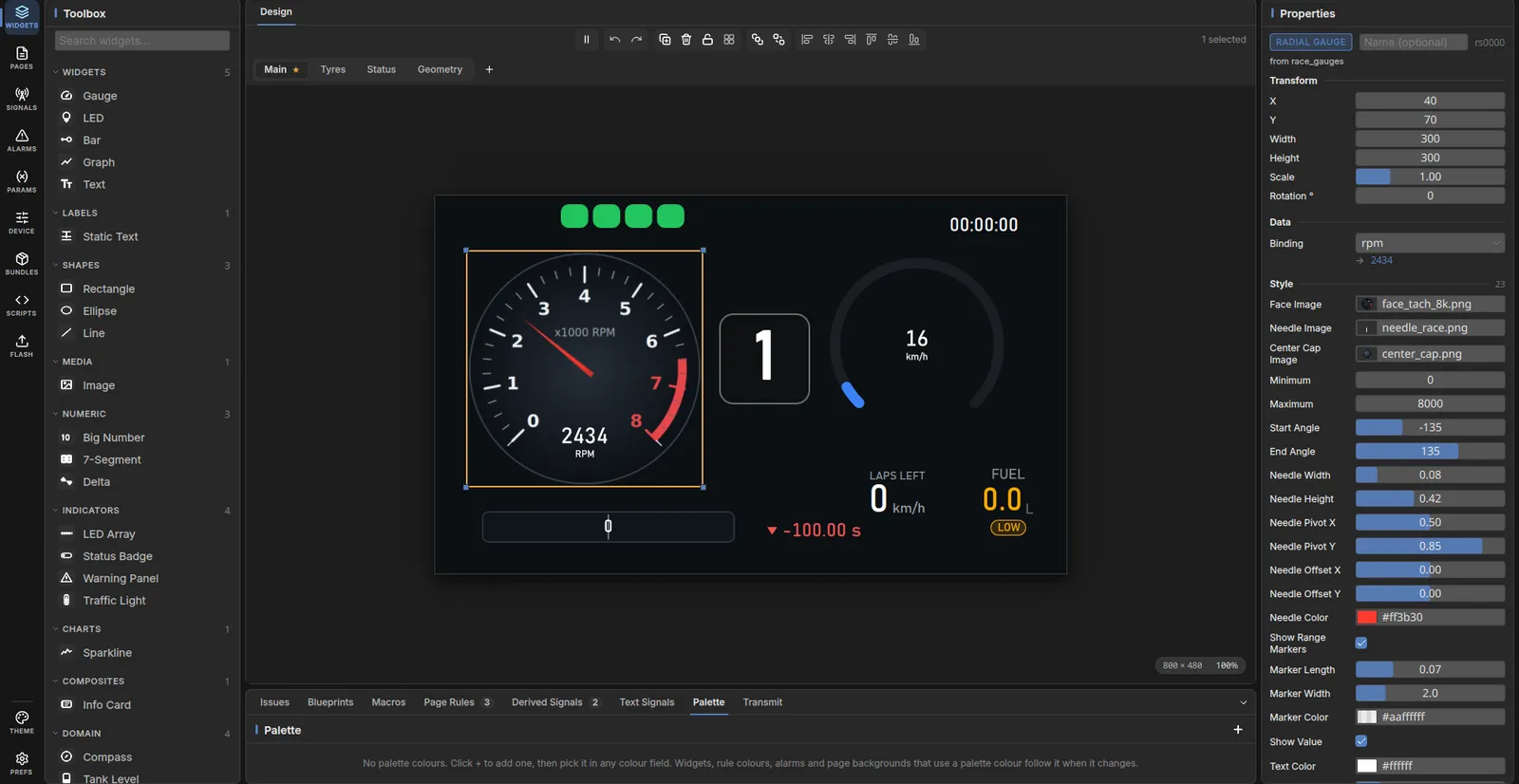
Dashboard designer app showing a tachometer, gear indicator and fuel widgets on an 800×480 canvas

At a glance

busiest page, after fixing a silently bypassed GPU path
12 → 40 fps
busiest page, after fixing a silently bypassed GPU path
firmware update over the car’s existing CAN bus
3.25 MB in ~55 s
firmware update over the car’s existing CAN bus
code generated: every design ships as a data manifest
0
code generated: every design ships as a data manifest

Designer

Drag. Drop. Done.

Teams lay out multi-page dashboards from 22 widget types, import their DBC file and simulate live signals before anything touches the car.

Dashboard designer app with a tachometer being configured

The idea

A manifest, not code.

The designer never generates firmware code. It exports a packed, versioned, CRC-checked binary manifest: widgets, pages, the CAN signal table and page rules. The firmware reads it at boot and builds the dashboard from it, so a new layout is a data update, never a rebuild.

0

lines of firmware code generated per design

On the car

Real data. Every frame.

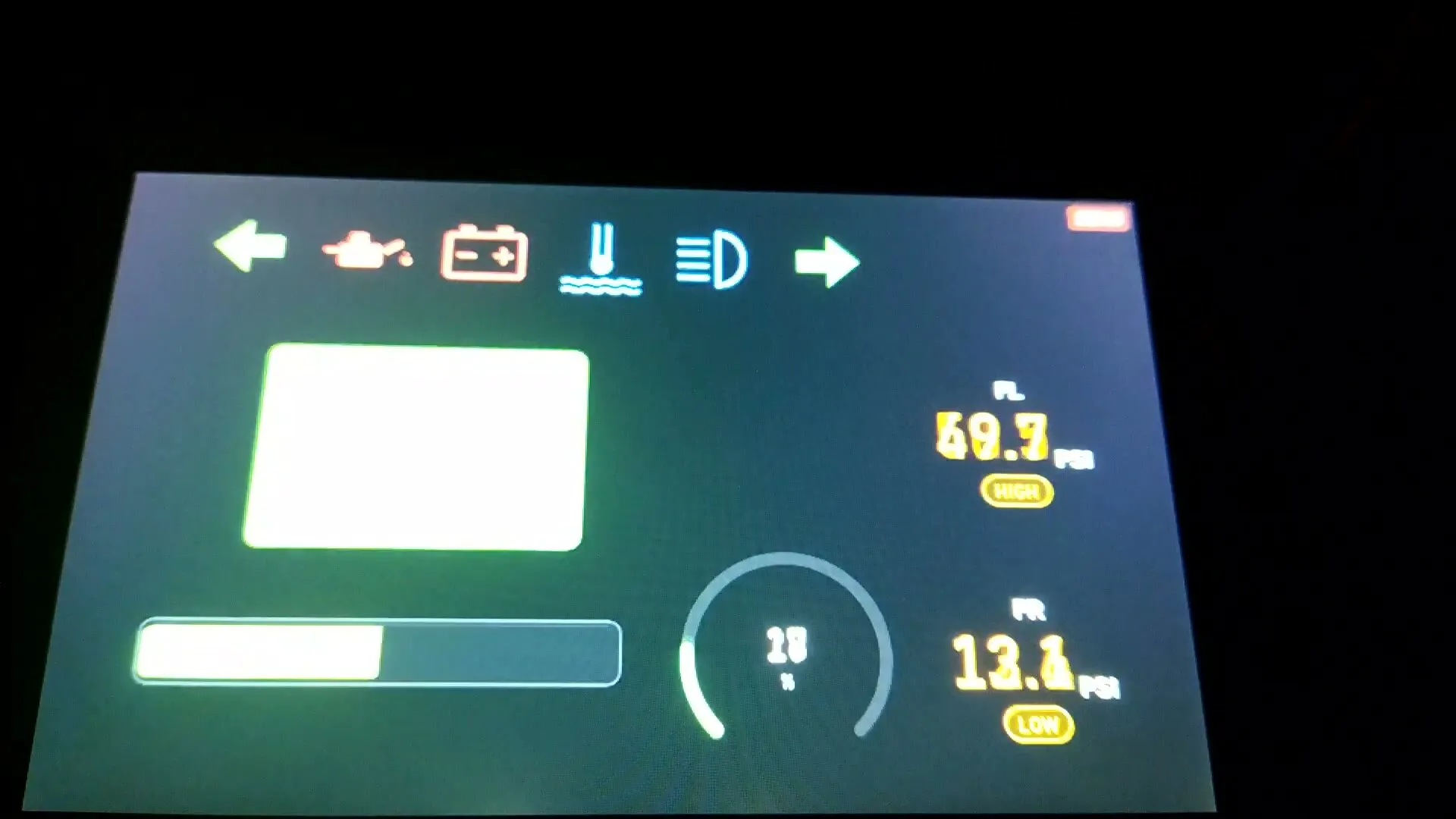
On the display, the runtime decodes 128 CAN signals plus 64 computed ones against the manifest's signal table in about half a millisecond of every 16 ms frame.

Dashboard running on the 5-inch display with live CAN data

Optional logic

Logic, sandboxed.

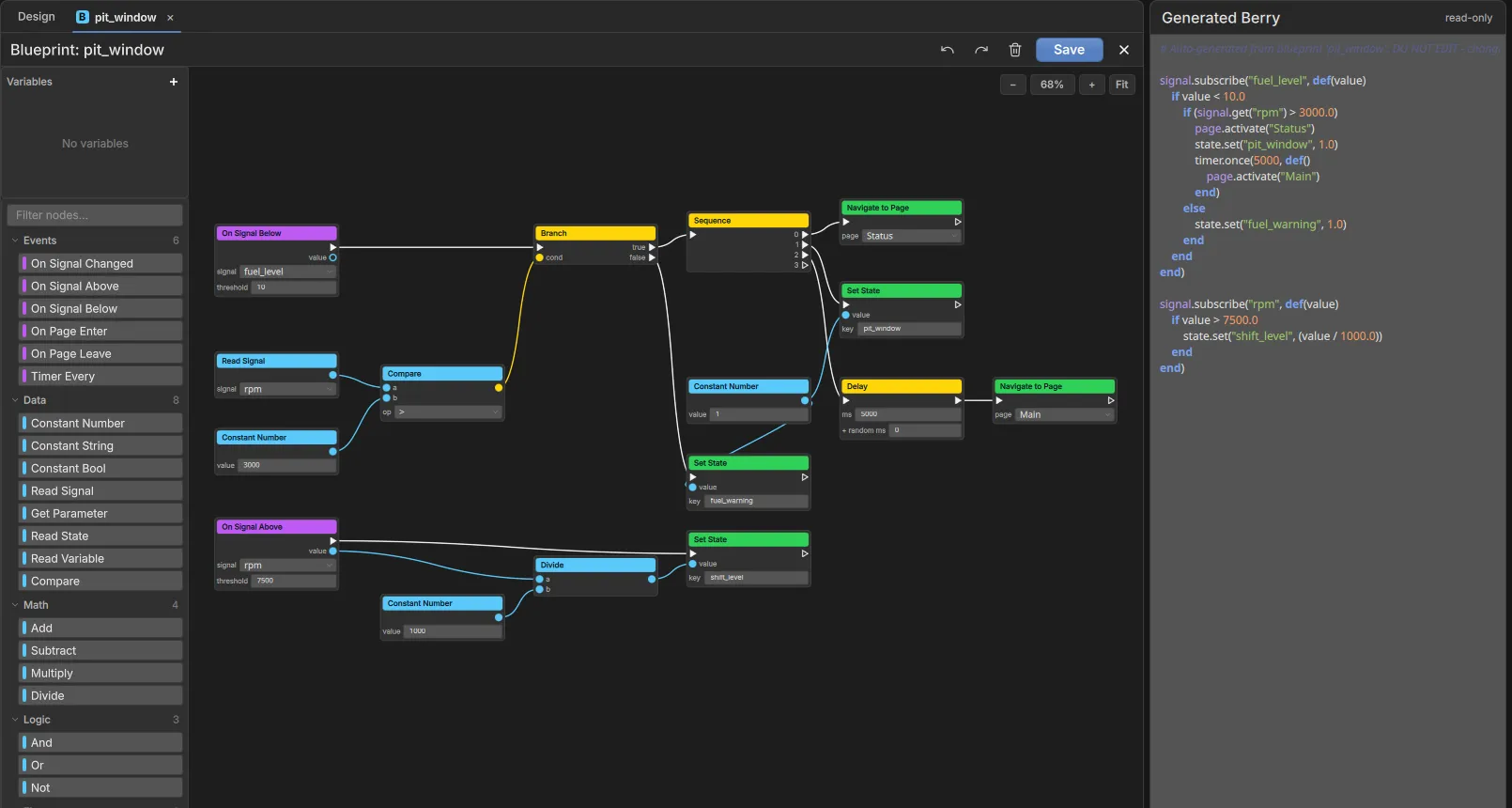
When a team needs behaviour beyond layout, like “low fuel in the pit window”, the blueprint editor adds an optional Berry script that runs in its own sandbox next to the manifest.

Node-based blueprint editor next to its Berry script

Updates

Over the wire it already has.

New manifests and firmware arrive over the car's CAN bus. Firmware uses A/B slots with automatic rollback if an image never confirms itself.

~55 s

for a 3.25 MB update over CAN

Measured

Faster. Lighter.

Busiest page frame rate

higher is better
Before
12 fps
After
40 fps

Frame draw time, smallest board

lower is better
Before
412 ms
After
210 ms

RAM in use, smallest board

lower is better
Before
99.9 %
After
87.6 %

Second-busiest page frame rate

higher is better
Before
14 fps
After
26 fps

Tech specs

Role
Lead engineer: firmware, desktop app, update protocol, licensing
Context
Contract for a European motorsport-electronics firm, via an embedded consultancy
Year
2026
Disciplines
Firmware, Software
Stack
  • Zephyr 4.4
  • LVGL 9
  • STM32F750
  • STM32U5 + NeoChrom GPU
  • MCUboot
  • Qt 6 / QML
  • C++20
  • Berry scripting
  • CAN / ISO-TP
  • DBC
Origin
Client work
The full engineering story

The problem

Race teams wanted to change what their dash shows (pages, gauges, warnings, shift lights) without asking an engineer to rebuild firmware. The display had to read the car’s CAN bus in real time, stay smooth on small microcontrollers, and be updatable in the paddock without opening anything up.

Constraints

  • Three display boards, two MCU families (Cortex-M7 running from QSPI flash, and STM32U5 with a 2D GPU), 800×480 panels.
  • No extra wiring for updates: the CAN bus is the only way in.
  • RAM was nearly full on the smallest board (99.9% at the start).
  • The client reviewed every milestone; four formal review rounds.

What I built

A desktop designer (Qt 6/QML). Drag-and-drop pages with 22 widget types, DBC import with live signal decoding and simulation, an optional 28-node visual scripting editor for extra behaviour (sandboxed Berry, kept separate from the layout manifest), multi-language UI, and a licensing system with offline, signed tokens.

A manifest interpreter in firmware (Zephyr + LVGL). The designer does not generate code. It exports a compact, versioned, CRC-checked binary manifest, and the device loads it from flash at boot and builds the UI from it: widgets, bindings, pages and page rules. Layouts change without recompiling anything. It decodes up to 128 CAN signals plus 64 computed ones in about 0.5 ms per 16 ms frame.

Updates over CAN. Firmware and dashboards are flashed over the car’s existing bus using ISO-TP/SMP with MCUboot A/B slots. A new image that doesn’t confirm itself within 60 s rolls back automatically. LZ4 compression and protocol tuning brought a 3.25 MB update to about 55 seconds.

The interesting bug

Pages rendered at 12–14 fps on the GPU board, worse than expected. Profiling showed LVGL was silently falling back to software rendering for most draw calls. After reworking the render path (GPU-friendly draw ops, page flipping with partial redraws, -O2 where it mattered) the busiest pages went 14 → 26 fps and 12 → 40 fps, and frame times on one page dropped from 412 ms to 210 ms on the smallest board, while RAM use fell from 99.9% to 87.6%.

Result

A shipped, versioned product (v0.9) with Linux, Windows and macOS builds of the designer, released firmware for three boards, and a team that can now redesign their dash between sessions.
Next

Touch Dash

Your dashboard. Redesigned with a fingertip.

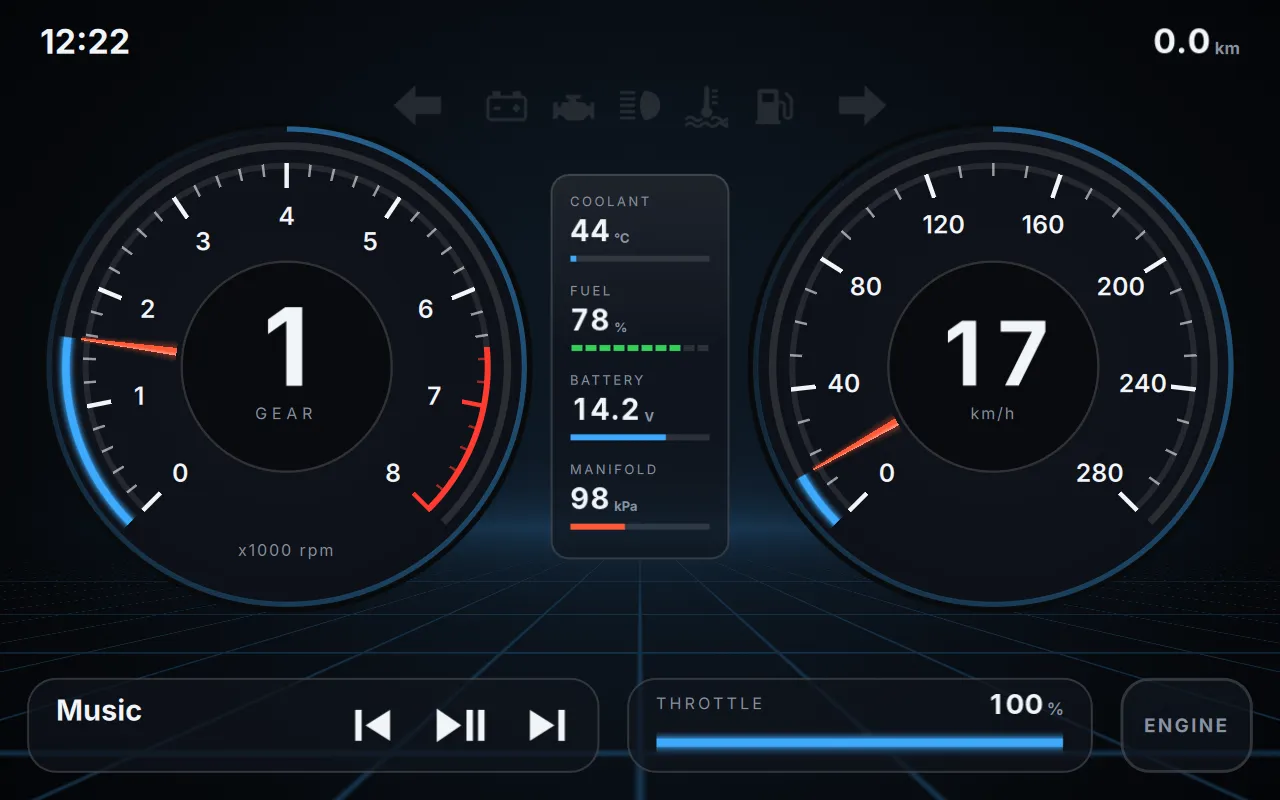
See the projectDark dashboard with tachometer, speedometer, coolant, fuel and battery readouts

Let's talk

Have a product to build?

Tell me what you are making. I reply within one working day, usually with first questions and a rough plan.

Or send a message
Esc